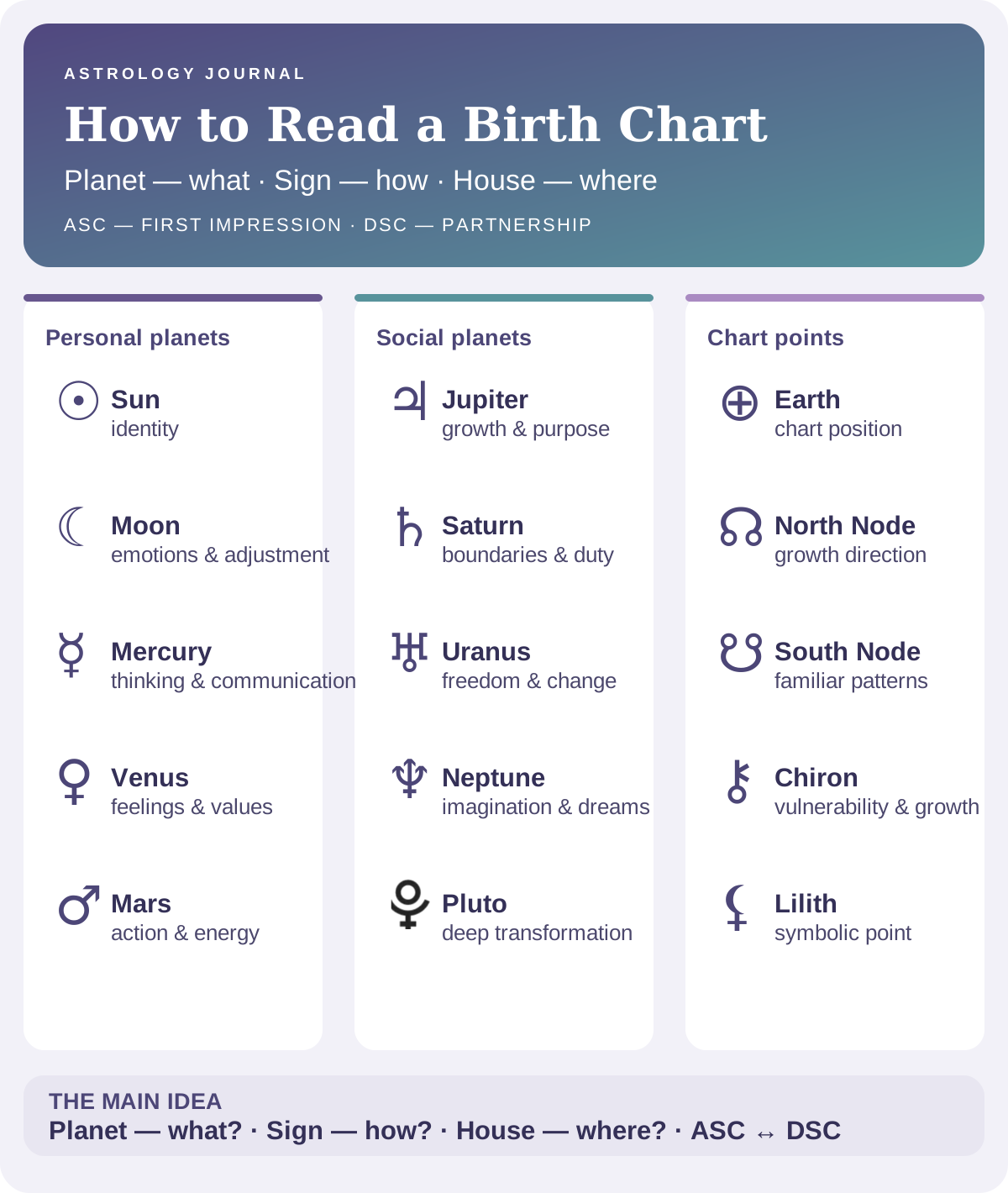
For example, Mars points to a theme around action and initiative. Its sign describes an astrological style of action, while its house connects that theme with an area of life. A fuller interpretation also considers aspects and the chart as a whole.
Planet, sign, and house: three layers
- Planet — what? A symbolic function or theme, such as thinking, feeling, action, or will.
- Sign — how? The style through which that theme is expressed.
- House — where? The area of life associated with the theme.
A glyph is a graphic symbol for a planet or another chart point. The circle with a dot represents the Sun, the crescent represents the Moon, and the circle with an arrow represents Mars. A glyph helps you find an element in the chart, but it is not a complete interpretation on its own. Don’t confuse a planet’s glyph with a zodiac sign: ♀ represents Venus; Taurus and Libra are signs Venus may occupy.
What the planets represent in astrology
- ☉ Sun: individuality, potential, will, and self-expression.
- ☽ Moon: emotional responses, adaptation, and how someone restores their energy.
- ☿ Mercury: thinking, learning, communication, and how information is received.
- ♀ Venus: affection, preferences, values, taste, and attitudes toward money.
- ♂ Mars: energy, initiative, action, and how someone asserts themselves.
- ♃ Jupiter: growth, social development, authority, and the search for purpose.
- ♅ Uranus: freedom, independence, and change. A constructive reading may emphasize reform and openness to new opportunities; a more challenging reading may focus on impulsiveness or difficulty with consistency.
These are broad symbolic themes, not labels for a person. Astrologers interpret each planet in its sign and house, along with its relationships to other chart points. Many modern charts also include ♄ Saturn, ♆ Neptune, and ♇ Pluto, traditionally associated with responsibility, imagination, and deep change. Astronomically, Pluto is classified as a dwarf planet.
The ASC–DSC axis: first impression and partnership
ASC is short for Ascendant: the point associated with the eastern horizon at the time of birth. In astrology, it is often linked with first impressions, how someone approaches new situations, and their outward style. The sign on the Ascendant describes how that theme may be expressed.
DSC, or Descendant, sits opposite the Ascendant. In symbolic interpretation, it is associated with partnership and one-on-one relationships. It does not identify a specific partner or guarantee a particular relationship outcome.
The lunar nodes: direction in symbolic interpretation
☊ and ☋ represent the North and South Lunar Nodes. Astronomically, these are the points where the Moon’s orbit crosses the plane of the ecliptic; they are not planets. Some astrological traditions call them a karmic axis: the North Node is interpreted as a direction for growth, while the South Node is associated with familiar or well-established patterns. “Karmic purpose” is a traditional symbolic concept.
The two nodes always sit opposite each other in a chart. About every 18.6 years, the transiting nodes return close to their birth-chart positions. This reflects the cycle of the Moon’s orbital nodes; the North and South Nodes do not switch labels in a birth chart.
Lilith: a calculated point, not a planet
Black Moon Lilith usually refers to a calculated point, not a physical celestial body. Some astrological schools associate it with fears, doubts, inner tension, or personal boundaries; other interpretations emphasize greater awareness of those themes. Calculation methods and meanings vary, so check which Lilith point your chart software uses. Chiron and other additional points may also appear in some systems.
A simple way to read a birth chart
- Identify the glyph and the planet or point it represents.
- Check the sign: this answers “how?”
- Find the house: this answers “where?”
- Consider aspects and the chart’s other connections.
For example, Venus is the theme (“what?”), its sign describes the style (“how?”), and its house identifies the area of life (“where?”). No one piece provides the full picture on its own.
Frequently asked questions
What does “planet = what, sign = how, house = where” mean?
It is a quick way to remember three layers of an astrological reading: the planet names a theme, the sign describes its style, and the house connects it with an area of life.
Are the lunar nodes planets?
No. Astronomically, they are points where the Moon’s orbit crosses the ecliptic. Their astrological meanings are symbolic interpretations.
What do ASC and DSC mean?
They are opposite points on one axis. ASC is the Ascendant; DSC is the Descendant. In astrology, the Ascendant is often associated with self-presentation, while the Descendant is associated with one-on-one relationships.
In short
Read a birth chart by moving from symbol to context: planet — what, sign — how, house — where. Then consider aspects and the ASC–DSC axis. The lunar nodes and Lilith are chart points with different astronomical definitions and symbolic interpretations. Learn more about how we calculate a chart in our birth chart calculation method.
The astrological meanings in this article describe a symbolic tradition; they are not a scientifically validated way to predict events or determine personality.